

Yes, you can use LED turn signals on a car or motorcycle in the United States. The question is whether the complete signal, as installed, meets the rules for that vehicle. A bright bulb or a product listing that says “street legal” cannot settle that question.
LED turn signals are legal in the U.S. when the lamp and its installation meet the applicable requirements. Front turn signals must flash amber; rear signals may flash amber or red. The light must also meet the rules for output, visibility, location and operation. Check the exact replacement assembly and vehicle, especially if you change the bulb type, move motorcycle signals closer together or add sequential lighting.
For a quick motorcycle check, the federal table specifies 16 inches between front signal centers and 9 inches between rear signal centers for the required lamps. There are other conditions, including a 4-inch front signal-to-headlamp clearance. A short, integrated tail light may fail that placement check even if both sides flash brightly. The table below shows where to start.
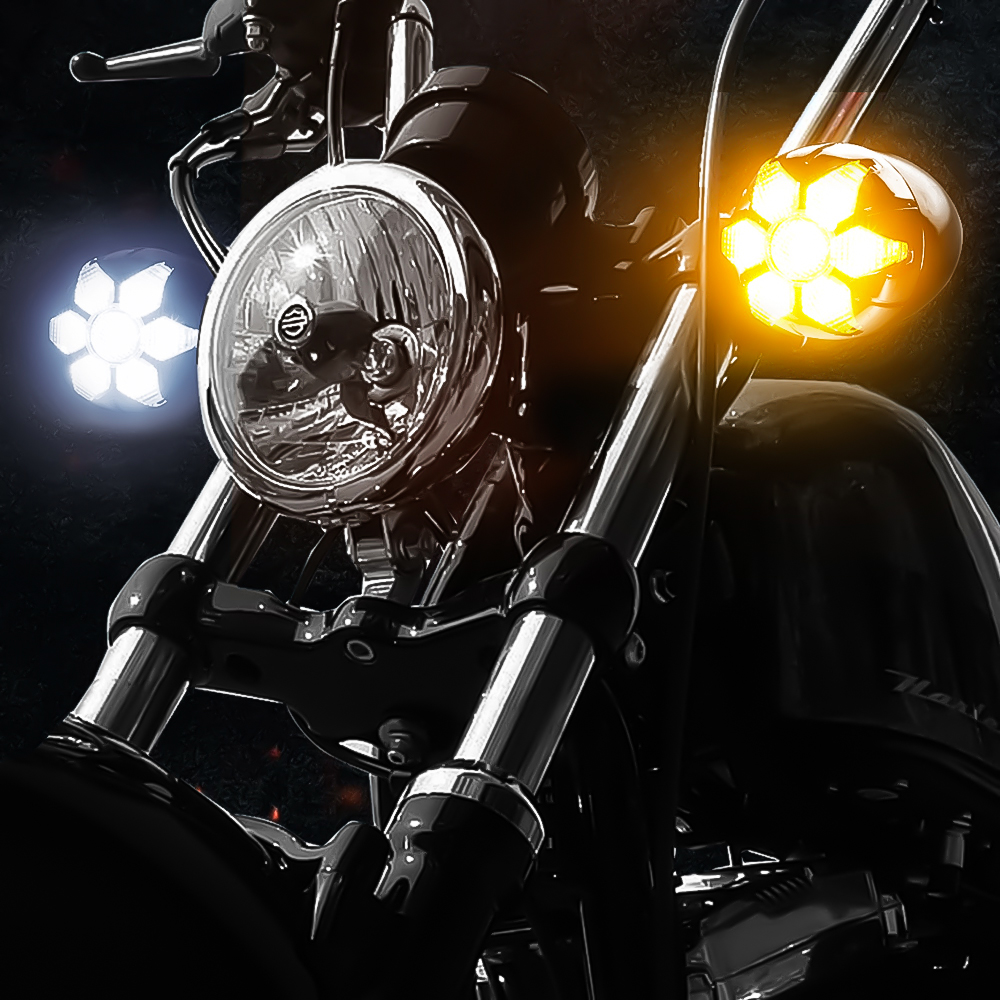
Are LED Turn Signals Legal Under U.S. Federal Rules?
Yes. Federal Motor Vehicle Safety Standard No. 108 (FMVSS 108) covers original and replacement vehicle lighting. It sets requirements for a turn signal’s color, light output, visibility, location and operation. It does not ban LEDs as a light source. NHTSA has also explained that a replacement lamp does not have to use the same type of light source as the original lamp, provided the replacement is designed to conform to the standard.
The following is a starting point for common U.S. passenger cars, trucks and motorcycles. It is not a test certificate for any particular product.
| What to check | Cars and trucks | Motorcycles |
|---|---|---|
| Front turn signals | Two amber flashing lamps, mounted at or near the front. | Two amber flashing lamps, subject to the motorcycle spacing rules below. |
| Rear turn signals | Two flashing lamps that emit amber or red. | Two flashing lamps that emit amber or red, subject to rear spacing rules. |
| Mounting height | Turn signals are generally mounted 15–83 inches above the road. | Turn signals are generally mounted 15–83 inches above the road. |
| Output and visibility | The complete lamp must meet the applicable photometric and visibility requirements. | The complete lamp must meet the applicable photometric and visibility requirements. |
| Operation | Required signals must flash when actuated; hazard operation must also work as required. | Required signals must flash when actuated. Check the bike’s indicator and hazard functions after replacement. |
Those color and placement details come from Tables I-a and I-c of FMVSS 108. The motorcycle table includes an exception for certain low-speed motor-driven cycles, so check the vehicle classification before applying its required-lamp count. For a normal street motorcycle with required signals, plan around the two-front, two-rear layout.
Federal equipment rules and state road-use rules answer related but different questions. For example, New York’s motorcycle equipment guide requires directional signals on motorcycles from 1985 onward and says front signals show amber while rear signals show amber or red. Your state may also inspect the way the lamps operate after installation. Check that state’s current requirements if you sell or ride there.
Is an LED Bulb Swap the Same as a Complete LED Turn Signal?
No. A replacement assembly has its own lens, optics and light source, which can be designed and tested together. NHTSA’s replacement-lamp interpretation says a compliant replacement need not copy the original light-source technology. An LED assembly can therefore be a valid replacement for an incandescent assembly.
An LED bulb placed inside the original incandescent lamp is a different question. The original reflector and lens were designed around the filament’s position and shape. Moving the source can change how much light reaches each required test angle, even when it looks brighter straight ahead. NHTSA has identified this optical concern and noted that bulb changes can affect the vehicle’s turn-signal pilot indicator.
| Upgrade | What must be checked | Buying decision |
|---|---|---|
| Complete LED assembly | Exact vehicle application, lamp performance, mounting and electrical behavior. | Choose it when the supplier can identify the correct model and provide product-specific evidence. |
| LED bulb in original housing | Output from the original optics with the new source, warning indicator and flash behavior. | Do not assume fitment or a bright garage test proves compliance. |
| Custom lamp or strip | Whether it replaces a required lamp or acts as a supplemental lamp, plus placement and interference. | Define the function and test the installed design before offering it for road use. |
The practical choice: if you want a predictable road-use replacement, start with a complete assembly developed for your vehicle and intended market. Confirm the exact assembly’s evidence; “complete” by itself is not a compliance claim.
Can Front LED Turn Signals Be White? What About Red Rear Signals?
A required front turn-signal function must emit amber in the U.S. A white front lamp may serve another allowed function, such as a parking lamp or daytime running lamp on an applicable vehicle, under that function’s own rules. It does not make white light an acceptable color for the required front turn signal.
A switchback product may display white while running, then switch to amber when you signal a turn. Judge both modes separately. Check what the lamp does during a turn, with the headlights on, with the hazard switch on and after the signal cancels. A sales photo showing a white running mode tells you little about the amber turn mode.
Rear turn signals may emit red or amber under FMVSS 108. A red rear signal is not automatically illegal in the U.S. If it shares an area with a brake or tail light, however, the combined functions must still work and remain distinguishable under the applicable standard. The fact that a red LED lights up behind a clear or smoked lens does not establish its complete performance.
With a smoked lens, inspect the assembled lamp in daylight and ask for the applicable output information. A darker cover added to a lamp after testing can change its light distribution. LOYO’s smoked tail light guide explains the same lens-versus-output distinction for rear lamps.

Motorcycle LED Turn Signal Spacing: Measure Before You Mount
Small motorcycle signals can be visible and still be mounted too close together. For required motorcycle turn signals, FMVSS 108 Table I-c specifies at least 16 inches between the centerlines of the two front lamps and 9 inches between the centerlines of the two rear lamps. It also specifies at least 4 inches from the edge of a front signal to the edge of the headlamp.
There is another rear condition: if the rear turn signals are red and the motorcycle has a single stop and tail lamp on its vertical centerline, the turn signals must be at least 4 inches edge to edge from that central stop or tail lamp. These are different measurements. Do not substitute outside-edge spacing for center-to-center spacing when you check a tail tidy or integrated light.
| Motorcycle measurement | Minimum | Measure between |
|---|---|---|
| Left to right front signals | 16 in (406 mm) | The centers of the two lamps. |
| Front signal to headlamp | 4 in (102 mm) | The nearest edges. |
| Left to right rear signals | 9 in (229 mm) | The centers of the two lamps. |
| Red rear signal to central stop/tail lamp, where the stated condition applies | 4 in (102 mm) | The nearest edges. |
The millimeter figures are rounded conversions from the inch values in the federal table. Measure the actual mounted lamp positions, including brackets and bodywork. If a pair of indicators sits inside one narrow tail-light housing, measure its signal centers rather than assuming the unit qualifies because it is sold as an integrated tail light. Also check whether saddlebags, a fender or a license plate bracket obstruct the required view.

Are Sequential LED Turn Signals Legal?
There is no reliable yes-or-no answer for every sweeping pattern. The first question is whether the sequence itself serves as the vehicle’s required turn signal or whether a separate compliant signal remains in place and the sequence is supplemental.
In one NHTSA interpretation of a specific required stop/tail/turn lamp, the agency found that the sequential turn and stop functions did not comply because the full required lighted area was not present when activated. That interpretation does not label every sequential product illegal. It shows why a supplier must assess the exact pattern, lamp area and intended function, instead of relying on the word “sequential.”
A separate NHTSA interpretation concerning supplemental turning lamps considers whether extra lighting impairs required lamps. If you are considering a sweeping Jeep fender lamp or an accessory strip, ask which component fulfills the required turn-signal function and how both lamps behave together during a turn and during hazard operation.
For example, LOYO lists a Jeep JL/JT fender-light assembly with sequential turn, daytime running and side-marker functions. Those listed functions help you ask the right questions. They do not establish U.S. compliance of that particular configuration without its product-specific records and an installed-function check.
Does Fast Blinking Make an LED Signal Illegal?
Fast blinking after an LED swap often means the vehicle’s flasher or body-control system sees a different electrical load. It can also signal a failed lamp or a wiring problem. Treat hyperflash or a dashboard warning as a fault to diagnose before driving or approving a product sample, not as a normal LED feature.
NHTSA has warned that an aftermarket motorcycle signal may affect the turn-signal failure indicator, hazard system or electrical loading. A replacement that flashes in a bench video may behave differently once connected to the bike. NHTSA’s motorcycle replacement-signal interpretation describes that system-level concern.
First confirm that both left and right lamps illuminate, the intended side is selected, the dash indicator behaves properly and the hazards work. Then check the vehicle’s wiring and the product’s recommended control method. An LED-compatible flasher, a vehicle setting or a properly specified load resistor may solve a load-detection problem on some applications. None of those parts proves the lamp’s color, light distribution or mounting compliance. Resistors also produce heat, so install them only according to the correct vehicle and product instructions.
Does a “DOT Approved” Label Prove the Turn Signals Are Legal?
No. NHTSA does not issue a product-by-product approval for replacement turn signals. Manufacturers are responsible for certifying that their equipment meets the applicable federal requirements. In a letter about replacement motorcycle signals, NHTSA specifically called “D.O.T. approved lights” misleading.
For a distributor or shop, ask the supplier for the exact part number, intended vehicle and market, covered functions, readable product marking where applicable, and evidence tied to that product. A factory registration number, a certificate for another lamp or a general list of company certifications cannot tell you whether this turn signal passes FMVSS 108 in its installed configuration.
Pass or stop: If the seller cannot identify what the lamp replaces, which functions it performs, how it mounts, and what product-specific evidence supports its road-use claim, do not advertise that lamp as street legal.
Five Checks Before You Buy or Sell LED Turn Signals
Identify the exact vehicle and original lamp
Record the make, model, year, trim, original lighting functions and destination state. Confirm whether you are replacing a complete assembly or only its bulb.
Check the colors in every operating mode
Run the front and rear turn functions, parking or running mode, braking if shared, and hazard mode. Choose amber for a required front turn signal; confirm the rear turn emits amber or red.
Measure the installed position
For motorcycles, measure signal centerlines and the applicable edge-to-edge gaps. Look for interference from the headlamp, luggage, fender and body panels.
Request evidence for the exact product
Match the model number, intended market, functions and applicable test or certification information. Ask how a sequential design fulfills the required signal function if it replaces one.
Test it on the vehicle
Check both sides in daylight, then test signaling with the brakes, headlights and hazards on. Resolve fast flashing, error messages or a failed indicator before the sample is approved.
For a wholesale or private-label project, keep the approved sample, part number, function video and application list together. A change to the lens, LED board, controller, housing or mounting hardware can change the answer, so review the new configuration before selling it under the same road-use claim.
Common Claims That Lead Buyers Astray
“LED Turn Signals Are Illegal”
False as a general claim. FMVSS 108 evaluates applicable lamp performance and installation, and NHTSA has said a replacement assembly need not use the original light-source type. A specific LED product can still fail those requirements.
“If It Is Bright, It Is Legal”
Incomplete. A lamp can look bright from directly behind and still have the wrong color, insufficient output at another required angle, poor separation or improper mounting. Ask for evidence on the complete assembly.
“All Sequential Signals Are Street Legal”
Too broad. The design must be assessed for its role as a required or supplemental light. A sweep that delays the required lighted area can create a compliance problem.
“A Resistor Makes the Upgrade Legal”
False. A resistor can address one type of load-detection problem. It cannot change a white front signal to amber, increase motorcycle signal separation or fix poor optics.
How LOYO Can Help You Check a Turn Signal Project
LOYO develops and manufactures vehicle lighting, including Harley-Davidson LED turn signals, BMW motorcycle turn signals and Jeep fender lights. A buyer should still assess each model separately. The vehicle platform, signal function and destination market determine which version and documents to request.
If you are sourcing an existing model or planning an OEM/ODM version, send the vehicle list, original lamp photos, required functions, target market and expected order quantity. LOYO can review the application and tell you which current model or development path should be checked at the sample stage. Ask for product-specific documentation before making a public road-use claim.
LED Turn Signal Legality FAQ
Are LED turn signals legal on motorcycles?
Yes, when the required signals meet the rules for color, output, visibility, location and operation on that motorcycle. For the federal motorcycle table, front lamps are amber, rear lamps are amber or red, and the required front and rear pairs have specified centerline separation.
Can I use white LED turn signals at the front?
No for the required U.S. front turn-signal function: it must flash amber. A lamp that shows white in a separate running mode and amber during a turn must be evaluated in both modes and under the rules for each function.
Are red LED turn signals legal at the rear?
Yes, FMVSS 108 permits amber or red rear turn signals for the covered U.S. vehicles. The complete lamp must still meet its other requirements. On a motorcycle with red rear signals and a single central stop/taillamp, check the additional edge-to-edge spacing condition.
Are smoked LED turn signals legal?
They may be, if the complete lamp still produces the required color, light output and visibility. A smoked appearance or a bright-looking LED is not proof. Tint film or spray added later can change the lamp’s tested performance.
Are integrated motorcycle tail lights with turn signals legal?
Do not decide from the product name. Measure the required rear signal centers: the federal motorcycle table specifies at least 9 inches between them. Also check emitted color, visibility, brake and turn operation, and the additional separation rule if red turn signals sit beside a single central stop/taillamp.
Are sequential LED turn signals legal?
It depends on the exact pattern and whether the lamp replaces a required signal or adds a supplemental effect. NHTSA has found one specific sequential required lamp noncompliant because the required illuminated area did not appear immediately. Request evidence for the design you plan to sell or install.
Do I need resistors to make LED turn signals legal?
Not automatically. Diagnose fast flashing or a dashboard warning on the intended vehicle, then choose the correct electrical solution. A resistor may fix load detection, but it does not establish lamp performance or proper mounting.
Does a DOT mark mean a turn signal is approved by NHTSA?
No. NHTSA does not pre-approve individual replacement turn signals. Ask for the exact product’s intended application and supporting compliance information; also check the state rules where the vehicle will be used.