

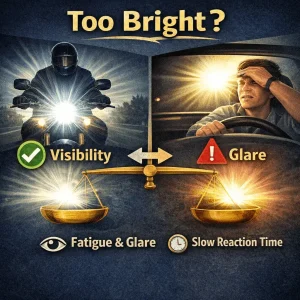
Motorcycle LED headlights do improve illumination a lot; they are typically brighter and more efficient, consistently providing superior lighting performance. However, is your motorcycle headlight too bright? Excessive brightness can create safety hazards. It puts the rider and other road users at risk. This guide will explain how to assess your LED motorcycle headlights, common causes of excessive brightness, adjustment methods, and the relevant engineering principles.
Table of Contents
Why Riders Feel Their Motorcycle Headlights are Too Bright
Many riders assume that a brighter headlight automatically improves safety, but that’s not always the case. Here are the main reasons headlights may seem too bright:
LED Technology and High Color Temperatures
- LEDs emit light at 6000–6500K, appearing whiter and brighter than halogen bulbs. Many modern vehicles, like motorcycles and trucks, have overly bright LED headlights that can dazzle other drivers.
- The “glare” primarily arises from the high color temperature of white light in LEDs and the limits of human visual adaptation, rather than just increased luminous flux.
- For those with sensitive vision, like astigmatism or cataracts, cool white LEDs (typically higher CCT, 5000K+) appear far more glaring and uncomfortable due to their stronger blue light component.
- Warmer LEDs (around 3000K–4300K) feel noticeably gentler on the eyes during night riding.
Optical Scatter
Degraded or low quality lenses make motorcycle headlight glare worse, cloudy, scratched, or poorly textured (non-Fresnel or improperly fluted) surfaces diffuse light further, scattering rays unpredictably and amplifying glare while dimming forward throw.
Voltage Fluctuations or Electrical Modifications
Aftermarket modifications may increase voltage slightly, causing LEDs to shine brighter than intended.
Improper installation or aiming
- The beam angle may be set too high during dealer installation or user adjustment.
- The vehicle’s built-in automatic leveling function may not work in some situations.
- Many US-spec vehicles are not inspected for beam angle at all.
Modern Vehicle Heights
- Light from elevated positions can directly enter the driver’s eyes or reflect in the rearview mirror.
- The higher a vehicle’s headlights are positioned, the more disruptive they can be to other drivers, especially to cars and motorcyclists.
6 Signs Your LED motorcycle Headlights Might Be Too Bright
- Incorrect aiming – Even a high-quality LED will blind others if aimed incorrectly.
- Poor beam pattern – Non-DOT LED motorcycle headlights often scatter light.
- Wrong headlight for your bike – Misfit lights create glare in motorcycle headlights.
- High beams used inappropriately – Using them in traffic or busy urban areas makes them appear brighter.
- Housing or lens design flaws – Oversized or misaligned housings can spread light improperly.
- Electrical modifications – Over voltage or an unstable PCB may boost brightness.
How to Properly Adjust Your Motorcycle Headlight
The “25ft Wall Method”. the classic method.
- Measure Baseline Height: Position the bike on level ground and measure the distance from the floor to the center of the headlight lens.
- Set the Distance: Place the bike facing a wall, with the front axle exactly 25 feet (approx. 7.6m) away from it.
- Mark the Target: Place a strip of tape on the wall at a height 2 inches lower than your initial headlight measurement.
- Simulate Riding Load: Sit on the bike while adjusting. Suspension sag caused by your weight significantly raises the light’s aim.
- Fine-Tune the Aim: Use a 5/32″ hex key on the adjustment screws (found behind the trim ring) to align the top edge of the low beam with the tape.
- Calibrate Before Replacing: Always check your aim before spending money on new LED headlights; most “dim” headlights are simply misaligned.
Tip: Many riders share that headlight aim isn’t static; riding weight and suspension compression can raise the angle once the bike is underway, even if a static check looks fine. Some riders also note that oncoming vehicles may flash not because your lights are too high, but because they think a bulb is out or because road bumps briefly tilt the beam upward. A practical tip is to perform a wall aiming test: mark where the low beam hits and check the cutoff line to ensure it isn’t too high. read more about how to adjust a motorcycle LED headlight.
Why Your LED Headlight Might Be Too Bright
Understanding root causes helps prevent glare:
- Incorrect aiming – Even a high-quality LED will blind others if aimed incorrectly.
- Poor beam pattern or cheap bulbs – Non-DOT LEDs often scatter light.
- Wrong headlight for your bike – Misfit lights produce unwanted glare.
- High beams used inappropriately – Switching them on in traffic or urban areas increases perceived brightness.
- Housing or lens design flaws – Oversized or misaligned housings can spread light improperly.
- Electrical modifications – Over voltage or unstable circuits may boost brightness.
How do you know if you are blinded by an oncoming motorcycle?
- You momentarily lose road detail after passing the motorcycle
- You instinctively squint, look away, or blink excessively
- The glare lingers after the motorcycle has passed
- Road signs flare or reflect excessively during the encounter
- You feel visually fatigued faster during night riding or driving
Bright vs. Blinding: the key distinction
A headlight can be:
- Bright but safe → well-controlled beam, proper cutoff
- Moderate in output but blinding → misaligned, poor optics
When (and How) to Use High Beams on a Motorcycle
| Riding Scenario | Recommended Light | Primary Goal | Pro Tip |
| Broad Daylight | High Beam | Conspicuity | Makes you stand out to distracted drivers. |
| Urban / City Streets | Low Beam | Courtesy | Avoids dazzling other drivers in well-lit areas. |
| Mountain / Dark Roads | High Beam | Depth Perception | Essential for spotting deer or gravel in turns. |
| Approaching Traffic | Low Beam | Safety Etiquette | Switch down when the vehicle is ~500ft away. |
| Following a Vehicle | Low Beam | Reduced Glare | Don’t blind the rider/driver in their mirrors. |
| Tunnels / Parking Lots | Low Beam | Stable Vision | Prevents disorienting reflections off walls. |
| Intersections (Blind) | Pulse / Flash | Alerting Others | A quick flicker can warn cars turning left. |
Engineering and Testing Perspective
Most guides stop at aiming. A professional approach includes:
- Lux Meter Testing – Quantitative measurement of illuminance.
- Beam Pattern Analysis – Evaluates the cutoff line, uniformity, and spread.
- Reflector vs. Projector Design – Projectors provide precise light control; reflectors can scatter light.
- Environmental Testing – Assess in rain, fog, and reflective conditions.
- Certification Verification – Choose DOT headlights for motorcycles
If you want a deeper breakdown, this article explains how reflector, projector, and TIR optics influence glare, cutoff sharpness, and usable light distribution.
How to Reduce Motorcycle Headlight Glare at Night
If you or others are blinded by headlights:
- Check the headlight aim and adjust.
- Switch to DOT compliant LED headlights for a controlled beam.
- Lower brightness with filters or shields if legal in your jurisdiction.
- Avoid using high beams when not needed.
- Use polarized riding glasses to reduce glare.
FAQ
What to do if LED MOTORCYCLE headlights are too bright?
- Adjust aiming, replace low quality bulbs with DOT LEDs, and check housing design.
- Conduct night tests to verify reduced glare.
How can I make lED motorcycycle headlights less bright?
- Use filters or anti-glare shields.
- Adjust vertical aim.
- Replace overly powerful bulbs with compliant alternatives.
Is it illegal if your MOTORCYCLE headlights are too bright?
- Not inherently, only if they exceed legal standards or are misaligned.
How to stop being blinded by headlights at night?
- Adjust your seating posture and helmet visor angle.
- Use polarized glasses.
- Maintain a safe following distance behind vehicles with bright lights.
How to reduce the effects of headlight glare at night?
- Learn how to aim motorcycle headlights properly.
- Use high-quality DOT-certified LEDs.
- Avoid high beams when approaching other vehicles.
Do LED motorcycle headlights need special aiming?
Yes. LED optics are different from halogen; proper alignment ensures cutoff lines are maintained.
Do higher lumens mean better nighttime visibility?
Beam shape and cutoff sharpness matter more than lumen numbers. High lumen headlights that flood light upward or sideways can reduce contrast and depth perception. Controlled beams concentrate usable light on the road where the rider needs it most.
Can glare be reduced without dimming headlights?
Yes.
Proper aim, correct mounting height, optical design, and controlled foreground illumination reduce glare without sacrificing usable road light.
Why motorcycles are more likely to cause glare than cars
Motorcycles are more sensitive to glare issues because:
- Smaller headlight assemblies
- Higher mounting variability (suspension sag, load, rider posture)
- Narrower beam optics that become problematic if misaligned
Even a compliant headlight can become blinding if the aim is off by just a few degrees.
Why Motorcycle Headlights Appear Brighter Than Before
- Modern Bulb Technology – LEDs are whiter and appear more intense.
- Vehicle Height & Road Conditions – SUVs reflect more light.
- Lens & Optical Design – Modern lenses can amplify perceived brightness.
- Emerging Adaptive Technologies – Smart headlight systems adjust intensity to minimize glare.
DIY Fixes for Overly Bright Headlights
- Learn how to aim motorcycle headlights with step-by-step alignment.
- Replace cheap or defective LEDs.
- Use DOT-compliant motorcycle headlights and housings.
- Add anti-glare shields or light diffusers.
- Verify adjustments in multiple night scenarios.
Conclusion: Ride Safe Without Blinding Others
LED Motorcycle headlights are essential, but excessive brightness can endanger riders and other road users. Following the steps above, integrating professional testing, and using DOT-compliant LED headlight ensures optimal visibility without creating glare.
Quick Checklist:
- Observe driver reactions.
- Verify the cutoff line and beam pattern.
- Use lux measurements for accuracy.
- Test in real-world night conditions.
- Choose DOT-certified lighting solutions.